

Inuit Circumpolar Council
Founded in 1977 by the late Eben Hopson of Barrow, Alaska, the Inuit Circumpolar Council (ICC) has flourished and grown into a major international non-government organization representing approximately 180,000 Inuit of Alaska, Canada, Greenland, and Chukotka (Russia). The organization holds Consultative Status II at the United Nations Economic and Social Council and is a Permanent Participant at the Arctic Council.
To thrive in their Circumpolar homeland, Inuit had the vision to realize they must speak with a united voice on issues of common concern and combine their energies and talents towards protecting and promoting their way of life. The principal goals of ICC are, therefore, to:
- Strengthen unity among Inuit of the circumpolar region;
- Promote Inuit rights and interests on an international level;
- Develop and encourage long-term policies that safeguard the Arctic environment; and
- Seek full and active partnership in the political, economic, and social development of circumpolar regions.
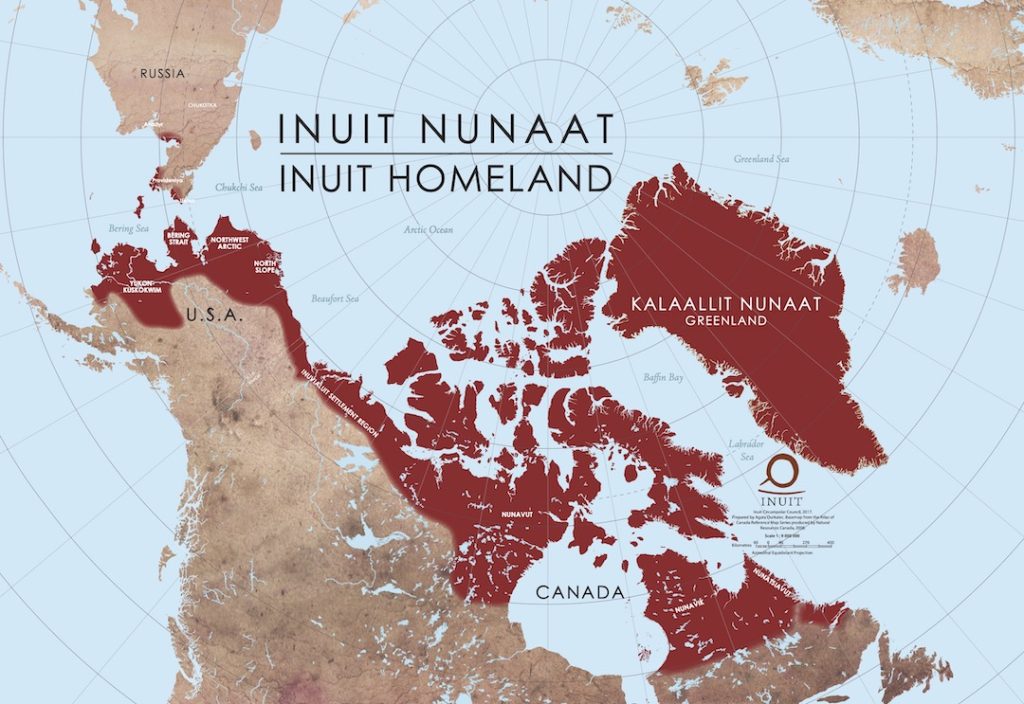
ICC holds a General Assembly every four years at which Inuit delegates from across the Circumpolar region elect a new Chair and an Executive Council, develop policies, and adopt resolutions that will guide the activities of the organization for the coming term. The General Assembly is the heart of the organization, providing an opportunity for sharing information, discussing common concerns, debating issues, and strengthening the bonds between all Inuit.
The ICC international office is housed with the Chair and each member country maintains a national office under the political guidance of a President.
In 2017, ICC celebrated its 40th anniversary and produced a short video reflecting on and celebrating the 40 years history of the organization.
History and Beginnings of the Organization
In 1973, several Greenlandic organizations based in Copenhagen hosted the first Arctic Peoples Conference. They invited members of the then Inuit Tapirisat of Canada (now known as Inuit Tapiriit Kanatami), the National Indian Brotherhood of Canada, and Saami from northern Finland, Norway and Sweden. Because neither Alaskan nor Russian Inuit were able to attend that event, the need for Inuit to meet as one indivisible people became clearly evident at that meeting.
Inuit visionaries such as Mayor Eben Hopson of the North Slope Borough, Alaska, were among those that never let go of the idea. When, in 1975, the World Council of Indigenous Peoples held its founding conference in Port Alberni, British Columbia, he had his special assistant, Billy Neakoq, deliver an invitation to a pan-Eskimo gathering to be held some time in the near future.
Planning, fundraising, and focused attention to this goal began in earnest. A grant submission made to an American foundation in 1975 contains the following statements: We Eskimo are an international community sharing common language, culture, and a common land along the Arctic coast of Siberia, Alaska, Canada and Greenland. Although not a nation-state, as a people, we do constitute a nation.
Inuit from Canada, Greenland, and Alaska discussed their common vision when Eben Hopson hosted the first ever the Inuit Circumpolar Conference in June of 1977.
At that historic and celebratory meeting, political resolutions were passed, poetry was read, and songs were sung. All 54 delegates (18 from each country) agreed to found an organization to carry on the task of working together on an international basis. The celebratory mood in 1977 was only dampened by the absence of Inuit from the former Soviet Union, whose arrival would have to wait several years.
Past General Assemblies
2026 – 15th General Assembly “Inuit Tapiriit Nunarjuarmi”
2022 – Virtual – 14th General Assembly “Inuit – Strength and Peace”
2018 – Utqiagvik, Alaska – 13th General Assembly “Inuit – The Arctic We Want”
- Visit the 13th General Assembly website for more information.
- Utqiagvik Declaration
- ICC Utqiagvik Declaration Implementation Plan
2014 – Inuvik, Canada – 12th General Assembly
2010 – Nuuk, Greenland – 11th General Assembly : Sharing Life – Innoqatigiineeq
2006 – Barrow, Alaska – 10th General Assembly : Unity Within Diversity
2002 – Kuujjuaq, Quebec – 9th General Assembly: Inuit Voice – Enlightening the World
1998 – Nuuk, Greenland – 8th General Assembly: Inuit Spirit for Global Partnership
Bill Edmunds Award
The Bill Edmunds Award is the highest award ICC presents to an Inuk during its General Assemblies. This award was established by ICC to honor those individuals who have made a selfless contribution to the promotion of Inuit rights and interests, with a particular focus on international endeavors.
Bill Edmund’s Award recipients:
- Eben Hopson Sr., Alaska 1986
- Dalee Sambo, Alaska 1989
- Rose Marie Kuptana, Canada 1992
- Andy Carpenter, Canada 1995
- Robert Petersen, Greenland 1995
- Ludmila Ainana, Chukotka 1998
- Aqqaluk Lynge, Greenland 2002
- Josie Kusugak, Canada 2006
- Mary May Simon, Canada 2010
- Carl Chr. Puju Olsen, Greenland 2014
- Tatiana Achirgina, Chukotka 2018
- James Stotts, Alaska 2026
Chair’s Office

Aluki Kotierk
Aluki Kotierk is currently the Chair of Inuit Circumpolar Council and the United Nations Permanent Forum on Indigenous Issues (UNPFII). She is driven by her passion to empower and improve the lives of Inuit. She is keen in how Inuit language and culture can be better incorporated into the way in which programs and services are designed and delivered in Nunavut.
Aluki is a former co-chair representing Indigenous People’s Organizations on the Global Task Force for the International Decade of Indigenous Languages (IDIL) 2022-2032.
After earning her master’s degree in Native and Canadian Studies at Trent University, Aluki Kotierk worked for various Inuit organizations including Pauktuutit Inuit Women of Canada, Inuit Tapirisat of Canada (now known as Inuit Tapiriit Kanatami), and Nunavut Sivuniksavut. She has also held management and Deputy Minister roles within the Government of Nunavut and Office Inuit of the Languages Commissioner. Aluki Kotierk was the President of Nunavut Tunngavik Incorporated (NTI) from 2016 to 2024.
Executive Council
The Executive Council is made up of the Chair, 1 Vice-Chair and 1 Member from each country (Alaska, Canada, Greenland and Chukotka). The Council is elected by their respective country delegation at the General Assembly to serve a four year term. The Council is responsible for providing direction to the ICC offices and implementing the Declaration mandates as directed by the delegates.
ICC Chair
Aluki Kotierk (Canada)
ICC Alaska
Marie Greene, Vice Chair
Nicole Wojciechowski, Member
ICC Greenland
Emma Lennert, Vice Chair
Nivi Rosing, Member
ICC Canada
Herb Nakimayak, Vice Chair
Natan Obed, Member
ICC Chukotka
Irina Meshcheriakova, Vice Chair
Marie Leita, Member